Outdoor flooring needs to withstand regular foot traffic, changing weather, and long-term exposure to moisture and sunlight. At the same time, the weight and structural design of the flooring boards can influence transportation, handling, installation, and overall project requirements. This is one reason why hollow WPC decking has become a practical option for various outdoor applications.
Unlike solid composite boards, hollow WPC decking features internal cavities within its cross-section. This design reduces material consumption while maintaining a structured profile. But how does this construction balance weight and structural performance? Understanding the relationship between board geometry, material composition, and installation conditions helps explain why hollow WPC flooring is widely used in outdoor spaces.
Hollow WPC decking is manufactured from wood plastic composite materials, typically combining wood fibers or wood flour with thermoplastic polymers and functional additives. The material is formed into boards with hollow channels running through their internal structure.
These cavities distinguish hollow boards from solid WPC decking. Instead of using composite material throughout the entire cross-section, hollow profiles distribute material around internal spaces to create a structured board.
The composition of the material also influences its performance. Wood fibers contribute to the natural appearance and rigidity of the composite, while plastic polymers help bind the components and improve moisture resistance. Additional additives can enhance processing characteristics, UV resistance, and other properties depending on the formulation.
One of the main advantages of hollow WPC decking is its reduced material volume. By introducing internal cavities, manufacturers can produce boards that use less composite material than comparable solid profiles with similar external dimensions.
This reduction can offer several practical benefits.
First, lighter WPC decking boards are generally easier to handle during transportation and installation. Moving and positioning individual boards can require less physical effort, particularly when working across large outdoor flooring areas.
Second, reduced material consumption can improve production efficiency. The amount of raw material required for each board is lower than that of a comparable solid profile, although the actual cost advantage depends on material prices, manufacturing processes, and product specifications.
However, lower weight does not automatically mean better performance. The internal geometry, wall thickness, material density, and overall manufacturing quality all determine how effectively a hollow board performs under load.
Although hollow WPC decking contains internal spaces, its structure is designed to distribute loads through the surrounding material.
The walls and connecting sections of the hollow profile contribute to its stiffness and resistance to bending. Their thickness, spacing, and arrangement influence how the board responds to applied loads.
Several factors are particularly important:
1. Profile Geometry
The shape and arrangement of internal cavities affect how forces travel through the board. A well-designed profile distributes loads across its structural sections rather than concentrating stress in one area.
2. Wall Thickness
The thickness of the outer walls and internal ribs influences the board's stiffness and resistance to deformation. Insufficient wall thickness may reduce structural reliability, while an optimized profile can balance material efficiency with mechanical performance.
3. Material Formulation
The ratio of wood fiber, plastic polymer, and additives affects the composite's strength, rigidity, and dimensional stability. Consistent material mixing and manufacturing quality are essential for producing reliable WPC floor panels.
4. Manufacturing Precision
Uniform extrusion, consistent dimensions, and controlled cooling help maintain the intended profile geometry. Variations in production can lead to uneven wall thickness or dimensional inconsistencies.
These factors work together. A lightweight hollow board can provide dependable performance when its profile is properly engineered for the intended application.
Both hollow and solid WPC decking have useful applications, but their structural characteristics are different.
| Comparison Factor | Hollow WPC Decking | Solid WPC Decking |
| Internal Structure | Contains hollow channels | Dense material throughout |
| Weight | Generally lighter | Generally heavier |
| Material Consumption | Lower for comparable dimensions | Higher for comparable dimensions |
| Handling | Easier to move and position | Requires more effort depending on size |
| Structural Behavior | Depends on cavity design and wall thickness | Depends on material density and board dimensions |
| Installation | Requires suitable support spacing | Also requires appropriate support and fixing |
Hollow WPC decking is often suitable for residential patios, garden walkways, balconies, and other outdoor flooring applications where reduced board weight is beneficial.
Solid WPC boards may be preferred in applications requiring particular structural characteristics or where their specific profile and material properties are better suited to the installation conditions.
Neither structure is universally superior. The appropriate choice depends on the expected loads, support system, board specifications, and environmental conditions.
Even a well-designed WPC decking board cannot perform properly without suitable installation.
The support structure is particularly important. Joist spacing should follow the manufacturer's specifications because excessive spacing can increase bending and deformation under foot traffic. Fixing clips and fasteners should also be compatible with the board profile.
Expansion gaps are another important consideration. WPC materials can expand and contract with temperature changes, so sufficient clearance should be provided at board ends and around fixed structures.
Drainage and ventilation beneath the decking should not be overlooked either. Standing water and restricted airflow can create unfavorable conditions for the supporting structure and surrounding installation.
For larger outdoor WPC flooring projects, checking the intended loading conditions and installation requirements before construction helps improve long-term stability.
The combination of reduced weight and structured construction makes hollow WPC decking suitable for a variety of outdoor environments.
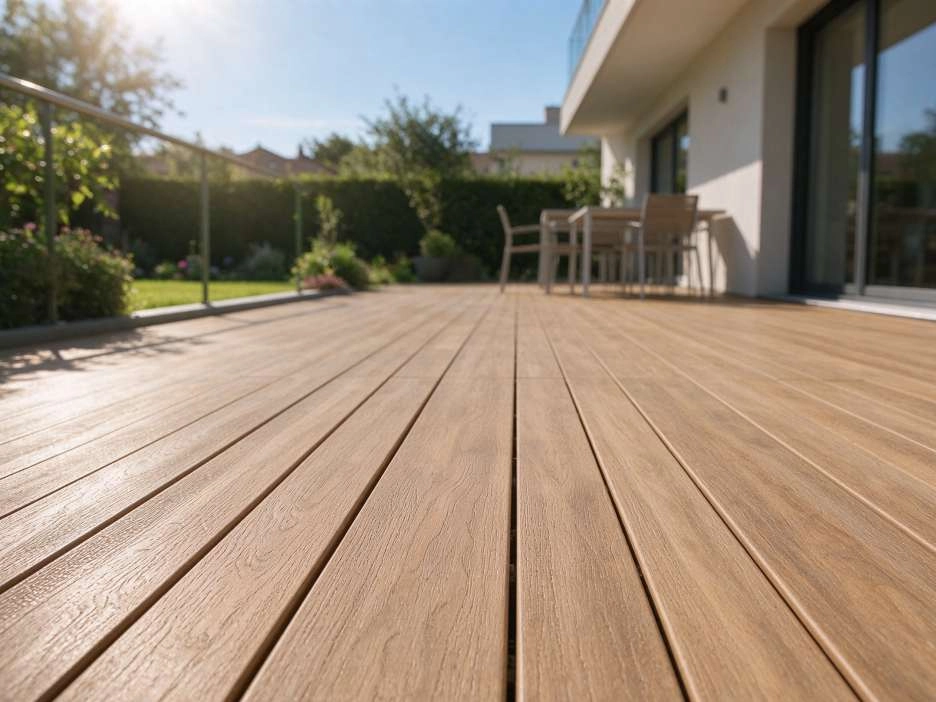
Common applications include garden paths, residential patios, balcony flooring, poolside areas, and outdoor leisure spaces. Its wood-inspired appearance also makes it easy to coordinate with landscaping, outdoor furniture, and contemporary architectural designs.
For example, Yuante's YT-A140H23 WPC decking board measures 140 × 23 mm and features a hollow profile with two different surface designs. One side has a grooved finish, while the other provides a flat surface, offering flexibility in appearance and installation planning.
The product is made with approximately 55% natural wood fiber, 35% recycled HDPE, and 10% additives. This composite formulation combines recycled plastic with wood-based material to create an outdoor flooring option with a natural appearance and practical maintenance characteristics.
For projects requiring lightweight composite boards and flexible surface styling, Yuante's Outdoor WPC Floor Panels are worth considering.
Hollow WPC decking demonstrates how structural design can improve material efficiency without sacrificing the practical performance required for outdoor flooring. Its internal cavities reduce material consumption and overall board weight, while the surrounding walls and ribs contribute to structural stability.
However, the final performance depends on more than whether a board is hollow or solid. Material formulation, profile geometry, manufacturing consistency, support spacing, and installation quality all play important roles.
By evaluating these factors together, it becomes easier to select suitable outdoor WPC flooring for patios, gardens, balconies, and other exterior spaces. A properly designed hollow WPC decking system can provide a practical combination of manageable weight, functional performance, and natural wood-inspired aesthetics.